This guide explains how loan interest works, how to use a loan interest calculator correctly, what your results actually mean, and how to use that information to borrow smarter. Whether you're financing a car, a home, or a personal expense, the numbers here will likely surprise you.
What Is a Loan Interest Calculator — and Why You Need One
A loan interest calculator is a tool that takes three or four inputs — your loan amount, interest rate, loan term, and compounding frequency — and instantly tells you your monthly payment, total interest paid, and total repayment amount. Some also generate a full amortization schedule: a payment-by-payment breakdown showing exactly how much of each instalment goes toward interest versus principal.
That last feature is where most people get their wake-up call.
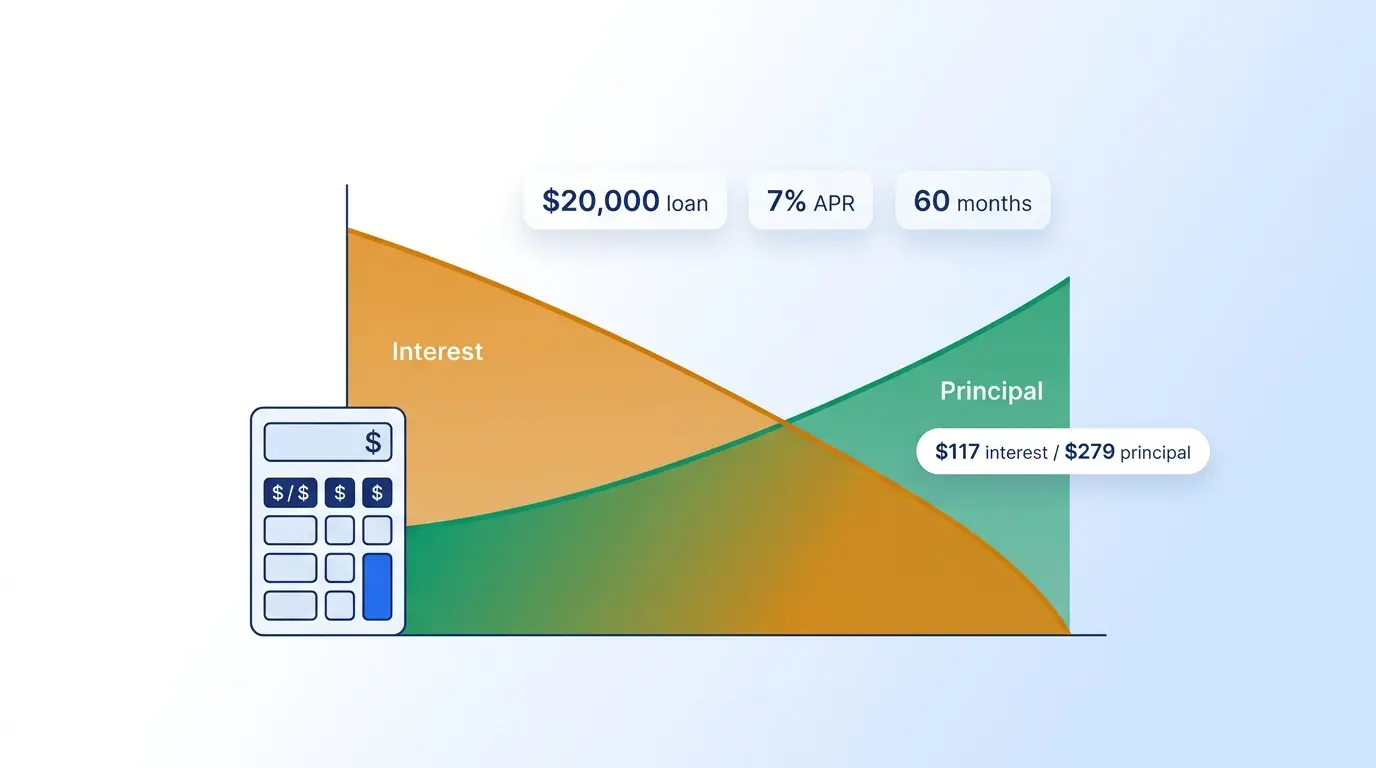
On a $20,000 car loan at 7% APR over 5 years, your monthly payment sits at around $396. That sounds manageable. But run it through a loan interest calculator and you'll see that in month one, $117 of that $396 payment is pure interest — money that reduces your balance by exactly zero. Over the full 60-month term, you'll hand over roughly $3,760 in interest on top of the $20,000 you borrowed.
Knowing that number before you sign gives you leverage. You can compare loan offers, negotiate terms, or decide to put more money down to reduce the principal. Ignorance, in this case, is genuinely expensive.
Enter your loan amount, rate, and term to get your monthly payment, total interest, and complete amortization schedule — instantly.
How Loan Interest Works: The Foundation You Need
Before you can use any interest rate calculator effectively, you need to understand what loan interest actually is and where it comes from.
Interest is the price of borrowing someone else's money. When a lender gives you $10,000, they're forfeiting access to that capital for months or years. During that time, they could have deployed it elsewhere and earned a return. Interest compensates them for that opportunity cost — and for the risk that you might default.
From your side, interest is the cost of accessing money now instead of waiting until you've saved enough. Sometimes that trade-off is worth it. Sometimes it isn't. A loan interest calculator helps you decide.
The Annual Percentage Rate (APR): Your True Cost Benchmark
Every loan quote comes with an interest rate, but the number you should always ask for is the APR — the Annual Percentage Rate. The APR rolls in not just the base interest charge but also origination fees, processing charges, and certain insurance premiums, expressing your all-in borrowing cost as a single annual percentage.
Here's the distinction in practice: a personal loan might advertise a 9% interest rate, but after a 2% origination fee, the true APR lands closer to 11%. On a $15,000 loan over three years, that difference adds up to several hundred dollars you weren't expecting.
Lenders know that most borrowers compare stated interest rates, not APR. Two loans with the same interest rate can have meaningfully different APRs depending on lender fees. Use APR as your single comparison number.
Simple Interest vs. Compound Interest: The Calculation That Changes Everything
This is the single most important concept for any borrower to understand, and it's the variable that separates a manageable loan from a financially damaging one.
How Simple Interest Is Calculated
Simple interest charges you only on the original principal — the amount you borrowed. The formula is straightforward:
Example: Borrow $5,000 at 8% simple interest for 3 years
Interest = $5,000 × 0.08 × 3 = $1,200
Total repayment = $5,000 + $1,200 = $6,200
The interest stays flat across the entire term because it's always calculated against the original $5,000 balance. Most personal loans, auto loans, and short-term instalment loans use simple interest. It's predictable, transparent, and easy to verify with a basic loan payment calculator.
How Compound Interest Is Calculated
Compound interest charges you on the principal plus any interest that has already accumulated. You pay interest on your interest. The formula is:
Example: Borrow $5,000 at 8% compounded monthly for 3 years
A = 5,000 × (1 + 0.08/12)^(12×3)
A = 5,000 × (1.00667)^36
A = 5,000 × 1.2702 = $6,351
Difference vs simple interest: $151 extra on a $5,000 loan
Scale that to a $250,000 mortgage or a revolving credit card balance, and compounding can cost you tens of thousands of dollars extra. Credit cards are the most dangerous example — most charge compound interest daily, which is why carrying a balance from month to month is one of the costliest financial habits you can have.
"Compound interest is either your greatest ally or your greatest enemy in personal finance. As a borrower, you're always on the wrong side of it — which is why understanding exactly how it works is not optional."
How to Use a Loan Interest Calculator: Step-by-Step
Running the numbers yourself takes less than two minutes when you know what to enter. Here's exactly how to get accurate, useful results from any online loan interest calculator.
-
Enter the Loan Principal
This is the total amount you're borrowing — not the purchase price of the item, but the actual loan amount. If you're buying a $25,000 car and putting $5,000 down, your principal is $20,000. -
Enter the Interest Rate (APR)
Use the APR, not the stated rate, for the most accurate picture of your borrowing cost. If you're still shopping and comparing offers, run the calculator once for each offer so you can compare total interest paid side by side. -
Set the Loan Term
Enter the repayment period in months or years, depending on which the calculator requests. Longer terms produce lower monthly payments but dramatically higher total interest — the calculator will show you exactly how much higher. -
Select Compounding Frequency
Most instalment loans compound monthly. Credit cards often compound daily. If you're unsure, monthly is the standard default. Changing this input from monthly to daily can noticeably increase the total interest shown on large loan amounts. -
Read the Full Output
Don't just look at the monthly payment. Pay attention to: total interest paid (the true cost beyond principal), total repayment amount (principal plus all interest), and the amortization schedule (payment-by-payment breakdown of interest vs. principal).
Monthly payment, total interest, APR comparison, and full amortization schedule — all in one free tool.
Reading Your Amortization Schedule: Where Your Money Actually Goes
The amortization schedule is the output most borrowers skip — and it's the most revealing number on the page.
When you take out a fixed-rate instalment loan, your monthly payment stays constant throughout the term. But the internal split between interest and principal shifts dramatically with each payment. Early in the loan, the lion's share of every payment goes to interest. Near the end, nearly all of it reduces your balance.
Here's how that plays out on the $20,000 car loan example at 7% APR over 60 months:
| Month | Payment | Interest Paid | Principal Paid | Remaining Balance |
|---|---|---|---|---|
| 1 | $396 | $117 | $279 | $19,721 |
| 2 | $396 | $115 | $281 | $19,440 |
| 3 | $396 | $114 | $282 | $19,158 |
| 30 (midpoint) | $396 | $62 | $334 | $10,577 |
| 58 | $396 | $7 | $389 | $789 |
| 59 | $396 | $5 | $391 | $398 |
| 60 (final) | $396 | $2 | $394 | $0 |
In month one, 30 cents of every dollar goes to interest. By month 60, that's dropped to less than one cent per dollar. The loan has gradually flipped from interest-heavy to principal-heavy — a process the lender designs, not you.
If you pay off the car loan above at month 30 instead of month 60, you eliminate every remaining row in the schedule. That saves roughly $1,200 in interest. Run that scenario in a loan payoff calculator before you make any extra payments — the savings are usually larger than people expect.
What Determines Your Interest Rate: The 5 Factors Lenders Weigh
Not every borrower gets the same rate. Lenders price loans based on risk — the higher the perceived risk that you won't repay, the higher the rate they charge. Understanding this system helps you take targeted steps to lower your rate before you apply.
1. Credit Score
Your credit score is the single most influential factor in your interest rate. It's a numerical summary — typically ranging from 300 to 850 — of how reliably you've repaid debts in the past.
The financial impact is larger than most people realise. The difference between a 620 and a 760 credit score on a 30-year $300,000 mortgage can exceed $80,000 in total interest paid. Improving your score before applying for a major loan is one of the highest-return financial moves available to you.
2. Loan Term
Longer terms typically carry higher interest rates because the lender assumes repayment risk over a greater number of years. They're also more profitable for lenders — a lower monthly payment looks attractive, but the extended timeline means you pay interest for far longer. Always run both a short-term and long-term scenario through your loan interest calculator before committing.
3. Secured vs. Unsecured Loans
Secured loans — backed by collateral like a home or vehicle — carry lower interest rates than unsecured loans. If you default on a secured loan, the lender can seize the asset. That protection reduces their risk and translates directly into a lower rate for you. Unsecured personal loans and credit cards carry no such backstop, which is why their rates are significantly higher.
4. Debt-to-Income Ratio (DTI)
Your DTI is the percentage of your gross monthly income that goes toward existing debt payments. Most lenders prefer a DTI below 36%, and many cap approval at 43–45%. A high DTI signals that you're already stretched financially, which increases your rate or limits your options entirely.
5. Macroeconomic Conditions
Central bank benchmark rates — set by institutions like the US Federal Reserve — ripple through every lending product in the economy. When benchmark rates rise, so do the interest rates on mortgages, personal loans, and car finance. The rate environment in 2023–2024 is a clear example: rates that were near historic lows in 2020–2021 climbed sharply, adding hundreds of dollars per month to payments for new borrowers in the same price range.
Fixed vs. Variable Interest Rates: Which Should You Choose?
Before you sign any loan agreement, you need to understand how your interest rate is structured over time. This choice has significant consequences — and the right answer depends on your situation.
Predictable from day one
Your rate is locked in and never changes, regardless of what happens in the wider economy. Your monthly payment is identical every month for the entire loan term.
Best for: Mortgages, auto loans, and personal loans where you want certainty over a long term.
Trade-off: Often set slightly higher than the initial variable rate, because the lender absorbs the risk of rate rises.
Adjusts with benchmark rates
Your rate shifts periodically — often annually or quarterly — in line with a benchmark rate like SOFR or a central bank base rate. Your payment can increase or decrease.
Best for: Short-term loans where you plan to repay quickly, or when you expect benchmark rates to fall.
Trade-off: If rates rise unexpectedly, your payment rises with them — as many ARM borrowers discovered in 2023.
In practice, most financial advisers recommend fixed rates for long-term borrowing and consider variable rates only if the initial rate advantage is significant and the loan term is short enough to manage the risk.
Strategies to Reduce Your Total Loan Interest
Understanding how a loan interest calculator works is only useful if you act on the information. Here are the most effective ways to reduce what you actually pay.
Make Extra Principal Payments
Any payment beyond your required monthly instalment reduces your outstanding principal, which reduces the interest charged in every future month. Even an additional $50 per month on a $20,000 car loan at 7% can shave four to five months off the term and save over $400 in total interest.
Refinance When Rates Drop
Refinancing replaces your existing loan with a new one at a lower rate. If your credit score has improved significantly since you took out the original loan — or if market rates have fallen — refinancing can reduce both your monthly payment and your total interest cost. Always calculate the break-even point: how many months of lower payments it takes to recover any refinancing fees.
Choose a Shorter Loan Term
A shorter term means a higher monthly payment but a dramatically lower total interest bill. Run both scenarios through an online interest rate calculator before you decide. On a $30,000 loan at 6% APR, choosing a 3-year term over a 5-year term can save over $2,800 in interest — money that stays in your pocket.
Improve Your Credit Score Before Applying
If your loan is not urgent, spend three to six months improving your credit score before you apply. Pay down existing balances, correct any errors on your credit report, and avoid new credit enquiries. Even a 40–50 point improvement can drop your rate by 1–2%, which compounds into thousands of dollars in savings over a long-term loan.
Avoid Minimum-Only Payments on Revolving Credit
On credit cards and lines of credit, paying only the minimum keeps you trapped in the compound interest cycle almost indefinitely. A $5,000 credit card balance at 20% APR, paid at the minimum rate, can take over 15 years to clear and cost more than $5,000 in interest alone — effectively doubling the original balance.
Key Takeaways
- A loan interest calculator tells you your monthly payment, total interest paid, and full repayment amount — always use one before signing any loan agreement.
- Compound interest charges you on accumulated interest, not just principal — it's significantly more expensive than simple interest on long-term or high-rate debt.
- The amortization schedule reveals that early payments are mostly interest; making extra payments early cuts your total interest bill disproportionately.
- Your credit score, loan term, and secured vs. unsecured status are the three factors you can most directly influence to lower your interest rate.
- Fixed rates offer certainty; variable rates carry risk — choose based on your loan term and your ability to absorb potential payment increases.
Monthly payment, total cost, amortization schedule, and extra payment savings. No sign-up needed.