
You've got the training part handled — you show up, you push hard, you log your lifts. But if the scale isn't moving and the muscle isn't showing, the problem is almost always the same one: your nutrition. Specifically, you're not eating in the right calorie surplus. Eat too little and there's no raw material to build with. Eat too much and you bury new muscle under a layer of fat.
Use this calorie calculator for muscle gain to instantly find your maintenance calories, your optimal bulking target, and your daily protein intake — all in one place. Then learn exactly how to use those numbers to lean bulk the right way, avoid unnecessary fat gain, and understand how fast real muscle growth actually happens.
How a Calorie Surplus Builds Muscle
Muscle is built when the rate of muscle protein synthesis outpaces the rate of muscle breakdown over time. Resistance training creates the signal to grow; protein supplies the building blocks; and a calorie surplus supplies the surplus energy your body needs to actually carry out construction. Building new tissue is metabolically expensive, and trying to do it while in an energy deficit is like trying to add rooms to a house while the contractor keeps tearing down walls for firewood.
That's why, for most trained lifters, a modest surplus is the most reliable lever for growth. The key word is modest. Above a certain point, extra calories don't translate into extra muscle — your body can only build new muscle so fast — so the surplus just gets stored as fat. The goal is to eat enough to fully support muscle growth and not a calorie more.
How Many Calories to Gain Muscle
Start with your maintenance calories — your Total Daily Energy Expenditure, or TDEE. This is the amount you'd eat to keep your weight perfectly stable. The calculator above estimates it from your age, sex, height, weight, and activity level. To gain muscle, you eat above that number.
For most people, a surplus of 250 to 500 calories per day is the sweet spot. Here's how to choose where you land in that range:
- Lean bulk (+250): The default for intermediate and advanced lifters who want to minimize fat gain. Slower, but cleaner.
- Standard bulk (+400): A solid middle ground for most people who want steady gains and aren't worried about a little extra fat.
- Aggressive (+500): Best reserved for true beginners and hard-gainers who genuinely struggle to put on weight.
For example, a 30-year-old man weighing 180 lbs at 5'10" who trains four days a week has a TDEE of roughly 2,650 calories. On a lean bulk, he'd eat about 2,900 calories per day. That small, consistent surplus — combined with progressive training — is what drives growth without ballooning his waistline.
Lean Bulk vs Dirty Bulk: How to Bulk Without Getting Fat
"Bulking" has earned a bad reputation, and dirty bulking is the reason. A dirty bulk means eating in a large, unstructured surplus — often "see food, eat food" — and watching the scale shoot up. The problem is that your body can only build muscle at a fixed maximum rate. Past that ceiling, every extra calorie is stored as fat, so a dirty bulk produces a lot of weight but a poor ratio of muscle to fat.
A lean bulk flips the equation. By keeping the surplus small and controlled, you supply just enough energy to maximize muscle growth while keeping fat gain to a minimum. You gain weight more slowly, but a much higher percentage of that weight is actual muscle — which means less fat to cut later and a better physique the whole way through.
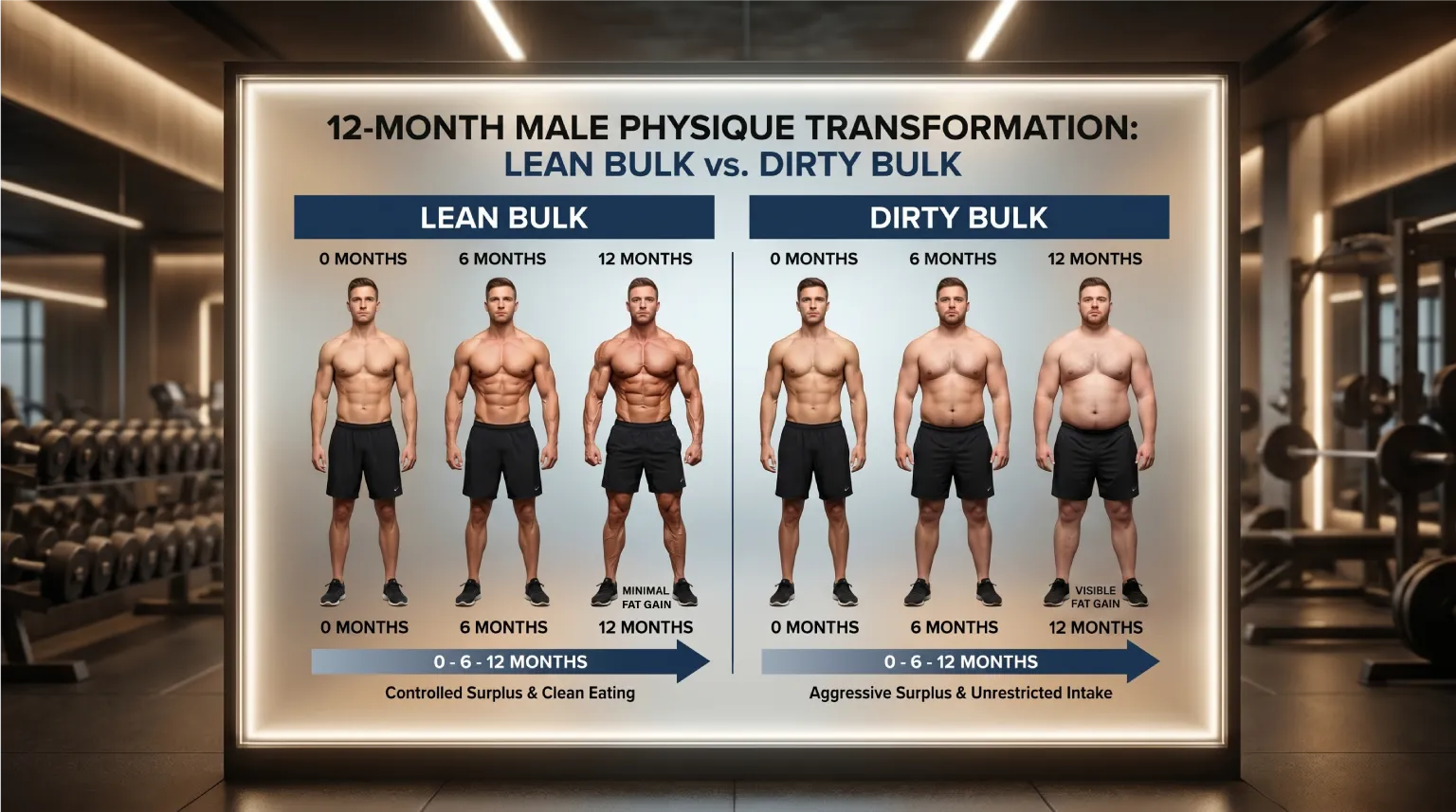
How to keep fat gain minimal while bulking:
- Use a small surplus. Start at +250 and only increase if your weight genuinely stalls.
- Cap your weekly gain. Aim for 0.25–0.5% of your body weight per week — no faster.
- Prioritize whole foods. Hitting a modest surplus on nutrient-dense food is much easier to control than chasing calories with junk.
- Bulk in a reasonable body-fat range. The leaner you start, the more of your surplus is partitioned toward muscle rather than fat.
Protein, Macros & Training: Turning the Surplus Into Muscle
A calorie surplus is permission to grow, not a guarantee. What you do with those calories — and in the gym — decides whether the extra weight becomes muscle or fat.
Protein comes first
Protein provides the amino acids your body uses to repair and build muscle tissue. The research consensus lands around 0.7 to 1 gram of protein per pound of body weight per day (roughly 1.6–2.2 g/kg). For most lifters, 0.8 g per pound is a clean, practical target — about 144 g for a 180 lb person. Spreading it across 3–4 meals helps keep muscle protein synthesis elevated throughout the day.
Carbs and fats fuel the work
After protein, the rest of your calories should split between carbohydrates and fats. Carbs fuel intense training and help with recovery, so don't fear them on a bulk — they're a lifter's best friend. Fats support hormone production, including testosterone, so keep them at a sensible minimum of around 0.3 g per pound of body weight.
Progressive overload is non-negotiable
The training stimulus is what tells your body to use the surplus for muscle. Without progressive overload — gradually adding weight, reps, or sets over time — extra calories have nowhere productive to go. Don't forget recovery, either: 7–9 hours of sleep is when most muscle repair actually happens.
Realistic Muscle Gain Rate & Timeline
Managing your expectations is half the battle. Muscle is built slowly, and the rate depends heavily on your training experience. The longer you've trained, the closer you are to your genetic ceiling, and the slower the gains.
| Training Stage | Realistic Muscle Gain (Men) | Realistic Muscle Gain (Women) |
|---|---|---|
| Beginner (year 1) | ~1.5–2 lb/month | ~0.75–1 lb/month |
| Intermediate (year 2–3) | ~0.5–1 lb/month | ~0.25–0.5 lb/month |
| Advanced (year 4+) | ~2–3 lb/year | ~1–2 lb/year |
Notice the scale weight you gain on a bulk will always exceed these numbers — that's because some of it is water, glycogen, and a little fat. That's normal and expected. The way to know your bulk is working is to track three signals together: a slow upward trend on the scale, your lifts getting stronger over time, and your measurements (arms, chest, legs) increasing while your waist stays relatively stable.
Frequently Asked Questions
The Bottom Line
Gaining muscle isn't complicated, but it is precise. Find your maintenance calories, add a small and controlled surplus of 250–500 calories, hit your protein, train with progressive overload, and let time do the rest. The lifters who build the best physiques aren't the ones who eat the most — they're the ones who eat just enough to grow and stay patient enough to let it happen.
Run your numbers through the calorie calculator here, lock in your bulking target, and reassess every few weeks. And once you've put on the muscle and want to lean back down, our guide on how to lower your BMI walks through the other side of the equation.