What Is a Calorie and Why Does It Matter?
A calorie is a unit of energy. Every food and drink you consume contains calories, and your body uses that energy to breathe, pump blood, digest food, think, walk, train, and recover.
When you consistently eat more calories than your body uses, the extra energy is stored, often as body fat. When you consistently eat fewer calories than your body uses, your body makes up the difference by drawing on stored energy. That is why knowing your daily calorie needs gives you a clear target for weight loss, maintenance, or muscle gain.
Most adults fall somewhere around 1,600 to 3,000 calories per day, but your personal number depends on age, sex, height, weight, activity level, body composition, and goal.
What Is BMR?
BMR stands for Basal Metabolic Rate. It is the number of calories your body burns at complete rest, just to keep you alive.
Think of it as the energy your body needs if you stayed in bed all day. Your heart still beats, your lungs still breathe, your brain still works, and your cells still repair themselves. All of that requires energy.
BMR accounts for a large share of total daily calorie burn for most people. That makes it the starting point for calculating your full daily calorie needs.
How Is BMR Calculated?
A widely used formula for estimating BMR is the Mifflin-St Jeor equation. It uses weight, height, age, and sex to estimate resting energy needs.
Men: BMR = (10 x weight in kg) + (6.25 x height in cm) - (5 x age) + 5
Women: BMR = (10 x weight in kg) + (6.25 x height in cm) - (5 x age) - 161
Worked Example
For a 30-year-old man weighing 80 kg and standing 180 cm tall:
BMR = (10 x 80) + (6.25 x 180) - (5 x 30) + 5
BMR = 800 + 1,125 - 150 + 5
BMR = 1,780 calories per day
This means his body burns about 1,780 calories per day before exercise and regular daily movement are counted.
What Is TDEE?
TDEE stands for Total Daily Energy Expenditure. It is the total number of calories you burn in a normal day, including BMR plus activity.
TDEE is usually the most useful calorie number because it reflects real life. Eating around your TDEE tends to maintain weight. Eating below it creates a deficit. Eating above it creates a surplus.
How Is TDEE Calculated?
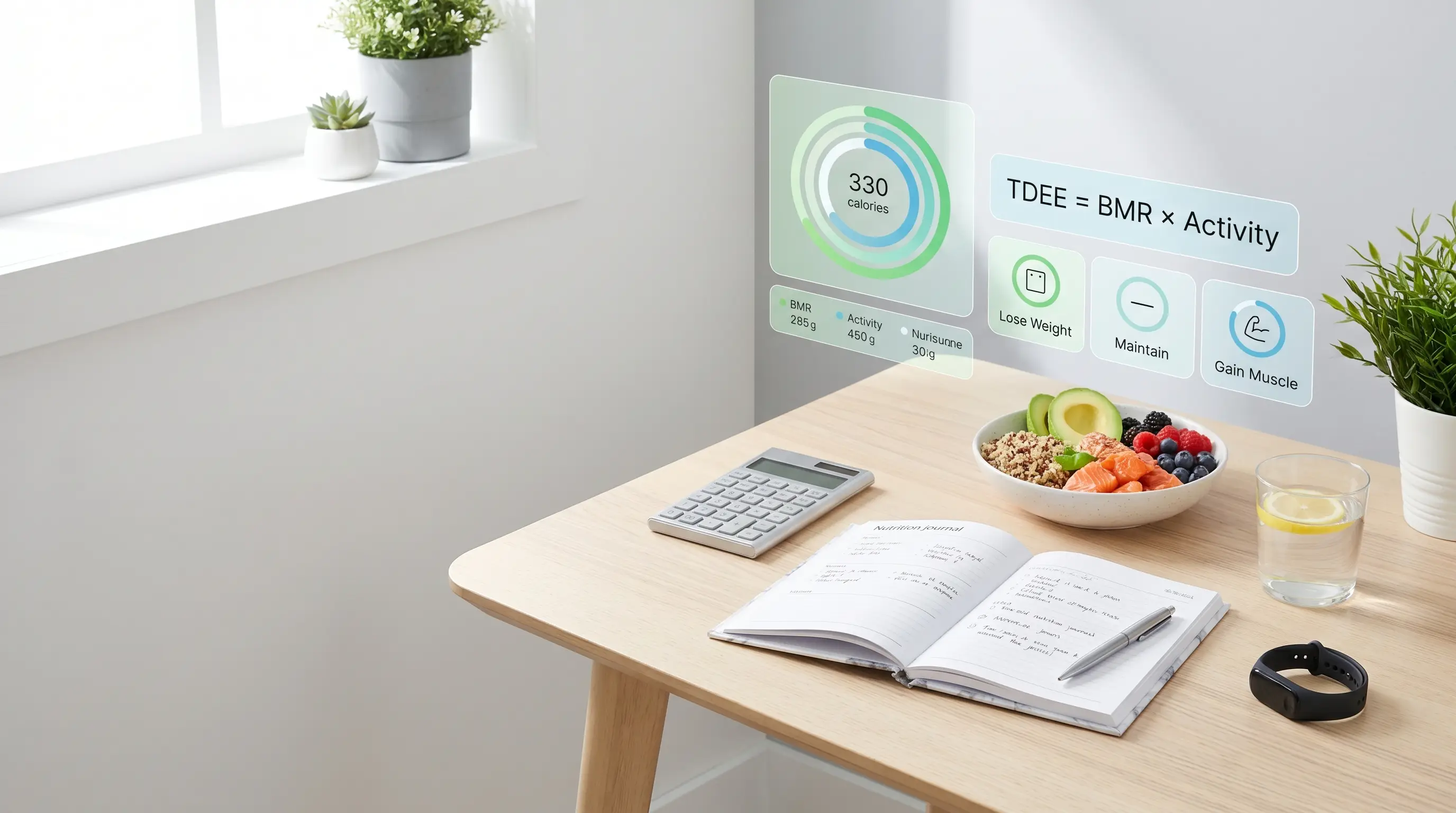
TDEE is calculated by multiplying your BMR by an activity factor:
| Activity Level | Multiplier | Who This Fits |
|---|---|---|
| Sedentary | x 1.2 | Desk job, little or no exercise |
| Lightly active | x 1.375 | Exercise 1-3 days per week |
| Moderately active | x 1.55 | Exercise 3-5 days per week |
| Very active | x 1.725 | Hard exercise 6-7 days per week |
| Extremely active | x 1.9 | Athlete, intense training, or physical labor job |
Worked Example Continued
The same 30-year-old man has a BMR of 1,780 calories and exercises 3-5 days per week:
TDEE = 1,780 x 1.55
TDEE = 2,759 calories per day
That is his estimated maintenance calorie level. If he eats close to 2,759 calories per day, his weight should stay roughly stable over time.
Use CalcMeter's calorie calculator to estimate BMR, TDEE, weight-loss calories, maintenance calories, and macro targets in seconds.
How Many Calories Should You Eat Per Day?
Once you know your TDEE, your daily calorie target depends on your goal.
Eat below TDEE. A mild deficit is easier to sustain; a larger deficit produces faster results but is harder to maintain.
Eat around TDEE. If your TDEE is 2,500 calories, 2,500 calories per day is your estimated maintenance target.
Eat slightly above TDEE while following a progressive resistance training plan.
Weight-Loss Calorie Deficits
- Mild deficit, about 250 calories: slower weight loss, often better for athletes or people preserving performance.
- Moderate deficit, about 500 calories: a common sustainable target for many adults.
- Aggressive deficit, about 750 calories: faster loss, best used carefully and often more appropriate for higher-BMI individuals under guidance.
Very low calorie targets can increase the risk of muscle loss, nutrient gaps, fatigue, and rebound eating. If you have a medical condition, are pregnant, are breastfeeding, have a history of disordered eating, or plan a very low calorie diet, talk with a qualified clinician first.
How Many Calories Should Women Eat Per Day?
Many sedentary adult women maintain weight somewhere around 1,600 to 2,000 calories per day. Active women often need 2,000 to 2,400 calories or more.
Pregnancy, breastfeeding, high training volume, body size, and physically demanding work can raise calorie needs. The exact target is best estimated from BMR and TDEE rather than a generic average.
How Many Calories Should Men Eat Per Day?
Many sedentary adult men maintain weight somewhere around 2,000 to 2,500 calories per day. Active men often need 2,500 to 3,000 calories or more.
Men doing serious athletic training or physical labor may need 3,500 calories or more per day. Again, your personal TDEE is a better guide than a broad average.
Why Most People Get Their Calorie Needs Wrong
Overestimating Activity Level
Many people choose "moderately active" because they exercise, but if they train for one hour and sit most of the remaining day, their true activity factor may be closer to lightly active.
Underestimating Calorie Intake
Portion-size guesses are often inaccurate. Oils, sauces, snacks, drinks, and restaurant meals can add up quickly. Tracking carefully for even one or two weeks can reveal where the gap is.
Not Recalculating as Weight Changes
As body weight drops, BMR often drops too. A calorie target that worked at 90 kg may not produce the same result at 75 kg. Recalculate after every 4-5 kg of weight change or after major activity changes.
Ignoring Adaptation and Consistency
Long dieting phases can make adherence harder and reduce daily movement. Maintenance breaks, resistance training, adequate protein, and realistic targets help keep the plan sustainable.
Simple Tips to Hit Your Daily Calorie Target
- Use a food scale for a short audit: even two weeks can improve your portion awareness.
- Plan meals in advance: it is easier to hit a target when the day is mapped before you get hungry.
- Prioritize protein: protein supports fullness and helps preserve muscle during weight loss.
- Recalculate monthly: update your target after weight changes, training changes, or lifestyle changes.
- Sleep enough: poor sleep can make hunger and cravings harder to manage.
Use a Free Calorie Calculator
Calculating BMR and TDEE manually is useful for understanding the logic, but a calculator is faster and less error-prone. The CalcMeter Calorie Calculator accounts for your sex, age, height, weight, activity level, and goal, then estimates your BMR, TDEE, daily calorie target, and macronutrient breakdown.
If you're focused specifically on fat loss, read our detailed guide on how to calculate BMR for weight loss — it covers all three formulas, a decision tree to pick the right one for your body type, and an exact step-by-step action plan with calorie targets.
Frequently Asked Questions
Sources
- CDC: Steps for Losing Weight
- CDC: Physical Activity and Your Weight and Health
- Dietary Guidelines for Americans, 2020-2025
Final Thoughts
Your daily calorie needs are not a one-size-fits-all number. Start with BMR, multiply by an activity factor to estimate TDEE, set your goal, and adjust based on real progress over two to three weeks.
When you stop guessing and start working from your actual calorie needs, sustainable results become much easier to manage, whether your goal is fat loss, muscle gain, or simply feeling better day to day.