The global average adult sleeps 6 hours and 40 minutes per night. The scientific consensus says adults need 7–9 hours. That gap — roughly 20–80 minutes of missing sleep per night — compounds into a serious cognitive and health deficit that most people have been living with for so long they've mistaken it for their baseline.
Understanding how much sleep you actually need (not how little you can survive on) is one of the highest-leverage health decisions you can make. This guide walks through the official recommendations by age group, the biology behind why sleep matters, and a practical method for calculating your own ideal schedule.
CalcMeter's Sleep Calculator works out your optimal bedtime or wake-up time based on 90-minute sleep cycles — free and instant.
How Much Sleep Does Each Age Group Need?
The American Academy of Sleep Medicine (AASM) and the CDC publish sleep recommendations based on decades of research linking sleep duration to health outcomes. These are the current guidelines:
| Age Group | Age Range | Recommended Sleep | Includes Naps? |
|---|---|---|---|
| Newborns | 0–3 months | 14–17 hours | Yes |
| Infants | 4–12 months | 12–16 hours | Yes |
| Toddlers | 1–2 years | 11–14 hours | Yes |
| Preschoolers | 3–5 years | 10–13 hours | Yes |
| School-age | 6–12 years | 9–12 hours | No |
| Teenagers | 13–18 years | 8–10 hours | No |
| Adults | 18–64 years | 7–9 hours | No |
| Older adults | 65+ years | 7–8 hours | No |
About 1–3% of people carry a genetic mutation (DEC2 or ADRB1) that allows them to function optimally on 6 hours or fewer. Unless a doctor has confirmed this, assume you are not one of them. Most people who claim to be "fine on 6 hours" are simply adapted to feeling chronically sleep-deprived — and laboratory testing of their reaction times and cognitive performance tells a different story.
Why do children need so much more sleep than adults?
During childhood and adolescence, the brain undergoes massive structural development. Sleep — particularly slow-wave (deep) sleep — is when the brain releases 95% of its daily human growth hormone (HGH), consolidates the day's learning into long-term memory, and clears metabolic waste products through the glymphatic system. Cutting sleep short during development has demonstrably worse consequences than cutting it short in adulthood.
The 4 Stages of Sleep Explained
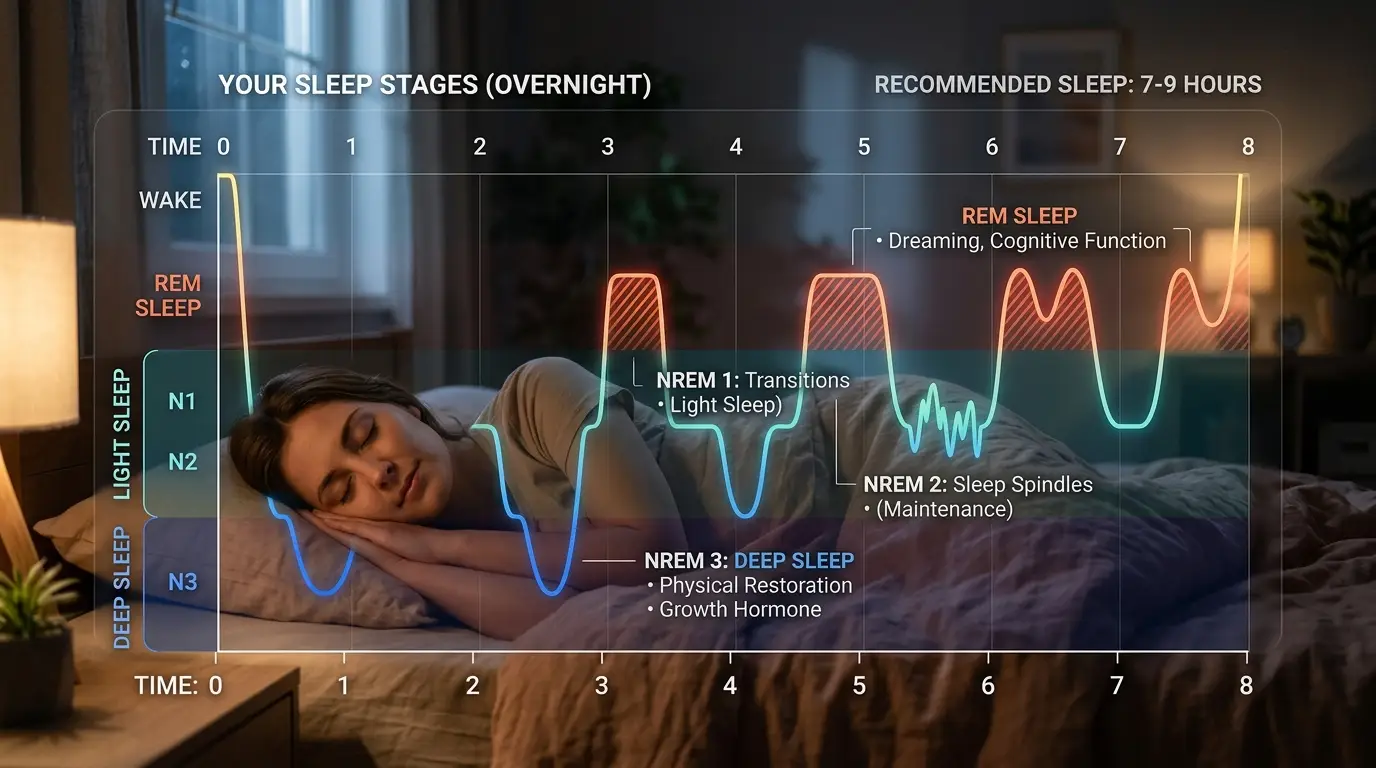
Sleep is not a single uniform state — it is a structured cycle of four distinct stages that your brain moves through roughly every 90 minutes. Understanding them explains why not all sleep hours are equal.
One complete cycle through all four stages takes roughly 90 minutes. Most people complete 4–6 cycles per night. The first cycles of the night are rich in deep sleep (N3); later cycles shift toward more REM. This is why a full 7.5 hours (5 cycles) typically feels more restorative than 8 hours that ends mid-cycle.
"The shorter your sleep, the shorter your life. The leading causes of disease and death in developed nations — from heart disease and obesity to dementia — all have causal links to insufficient sleep." — Matthew Walker, neuroscientist and sleep researcher
Is 6 Hours of Sleep Enough?
This is one of the most searched sleep questions online — and the answer is almost always no, but it requires context.
Research from the University of Pennsylvania found that sleeping 6 hours per night for two weeks produced cognitive impairment equivalent to two full nights of sleep deprivation. The critical finding: participants in the 6-hour group consistently reported feeling only slightly sleepy — they had lost their ability to accurately assess their own impairment. Performance on reaction time tests, working memory, and problem-solving told a very different story.
| Sleep Duration | Cognitive Impact | Health Risk (long-term) |
|---|---|---|
| 9 hours | Optimal for most adults | Minimal |
| 7–8 hours | Within recommended range | Low |
| 6 hours | Measurable impairment; felt as "mild sleepiness" | Elevated |
| 5 hours | Significant impairment equivalent to moderate intoxication | High |
| < 5 hours | Severe — microsleeps, hallucinations possible | Very High |
The exception: a small number of people carry the DEC2 or ADRB1 gene variants and genuinely need less sleep. If you suspect this, the only reliable test is a formal sleep study — not self-assessment.
What Sleep Deprivation Does to Your Body
Sleep deprivation effects are dose-dependent and cumulative. Here is what the research shows at different durations without adequate sleep:
One long sleep on the weekend does not fully reverse a week of short nights. Research by the University of Colorado found that weekend recovery sleep restored alertness but did not reverse the metabolic damage (insulin resistance, weight gain markers) caused by five nights of 5-hour sleep. Consistent nightly sleep is the only reliable strategy.
How to Calculate Your Ideal Bedtime
Because sleep cycles run roughly 90 minutes, waking at the end of a cycle feels dramatically better than waking mid-cycle. The trick is to work backwards from your target wake time.
The formula: Target wake time − (90 min × number of cycles) − 15 min fall-asleep buffer = ideal bedtime
| Wake-Up Time | 4 Cycles (6 hrs) | 5 Cycles (7.5 hrs) | 6 Cycles (9 hrs) |
|---|---|---|---|
| 5:00 AM | 10:45 PM | 9:15 PM | 7:45 PM |
| 6:00 AM | 11:45 PM | 10:15 PM | 8:45 PM |
| 7:00 AM | 12:45 AM | 11:15 PM | 9:45 PM |
| 7:30 AM | 1:15 AM | 11:45 PM | 10:15 PM |
| 8:00 AM | 1:45 AM | 12:15 AM | 10:45 PM |
All bedtimes above include a 15-minute buffer for falling asleep. If you tend to fall asleep faster or slower, adjust accordingly. For a personalized calculation with more wake-up options, use the free Sleep Calculator below.
Enter your wake-up time and the calculator shows every sleep-cycle-aligned bedtime — plus how many hours each option gives you.
7 Tips to Improve Sleep Quality (Not Just Duration)
Getting enough hours is the baseline — but sleep quality determines how restorative those hours actually are. These evidence-backed habits improve both sleep onset and the depth of your sleep cycles:
- Keep a consistent wake time, even on weekends. Your circadian rhythm is set primarily by your wake time, not your bedtime. A fixed wake time anchors your biological clock more reliably than a fixed bedtime.
- Avoid bright light for 1–2 hours before bed. Blue-spectrum light from phones and screens suppresses melatonin production by up to 50%. Dim your environment, use night mode, or wear blue-light glasses after 9 PM.
- Keep your bedroom cool — around 18°C / 65°F. Core body temperature must fall by 1–2°C to initiate and maintain sleep. A cool room accelerates this drop and increases the proportion of deep sleep.
- Avoid alcohol within 3 hours of bedtime. Alcohol may help you fall asleep faster but dramatically fragments sleep architecture — especially REM sleep — in the second half of the night, leaving you feeling unrefreshed despite a full night in bed.
- Cut caffeine by early afternoon. Caffeine has a half-life of 5–7 hours. A 3 PM coffee still has half its caffeine active at 9–10 PM, raising your arousal threshold and delaying sleep onset.
- Exercise regularly — but not within 2–3 hours of bed. Regular aerobic exercise increases slow-wave sleep. However, vigorous exercise within 2–3 hours of bedtime elevates core temperature and adrenaline, which can delay sleep onset.
- Use your bed only for sleep (and sex). Working, scrolling, or watching TV in bed trains your brain to associate the bed with wakefulness. Over weeks, this psychological association erodes your sleep drive when you actually want to sleep.
5 Sleep Myths That Won't Die
You can train yourself to feel less sleepy on less sleep — by reducing your awareness of impairment. The underlying cognitive deficits remain. No published study has shown that habituation to sleep restriction restores objective performance.
Survivorship bias at its most dangerous. Many high-achievers who claimed to sleep very little were either misrepresenting their habits (including naps), carried the rare DEC2 mutation, or paid a health price later in life. Most well-documented high performers — including athletes, executives, and scientists who track their own performance — sleep 7–9 hours.
Older adults often get less sleep — but this reflects a reduced ability to generate sleep, not a reduced need for it. Sleep deprivation in older adults is associated with faster cognitive decline and higher dementia risk. The recommendation drops only slightly: from 7–9 hours (adults) to 7–8 hours (65+).
Alertness partially recovers, but metabolic and cardiovascular markers impaired by a week of short sleep do not fully normalize. A 2019 University of Colorado study found that metabolic damage from 5 nights at 5 hours was not reversed by two nights of unrestricted recovery sleep.
REM sleep produces the most vivid, narrative dreams. But dreaming also occurs during N2 and N3 — it is typically less visual and more thought-like. REM dreams are more bizarre and emotionally intense because the prefrontal cortex (logical reasoning) is less active while the limbic system (emotion) is highly engaged.