Somewhere between school and adult life, most people pick up a half-knowledge of percentages — enough to know that 50% means half, but not quite enough to confidently calculate a 17.5% service charge on a restaurant bill without reaching for their phone.
Percentages are one of the most universally useful pieces of maths there is. They appear in exam results, tax rates, investment returns, food labels, discount signs, sports statistics, and payslips. Yet they're surprisingly poorly taught — usually as a single formula, when in reality there are six different types of percentage problem, each requiring a slightly different approach.
This guide will cover all six. We'll start with the one formula they all come from, then walk through each type with clear worked examples, common mistakes, and the fastest mental shortcuts.
Use CalcMeter's free Percentage Calculator — all 6 types in one tool, with formula shown.
The One Formula Behind Every Percentage
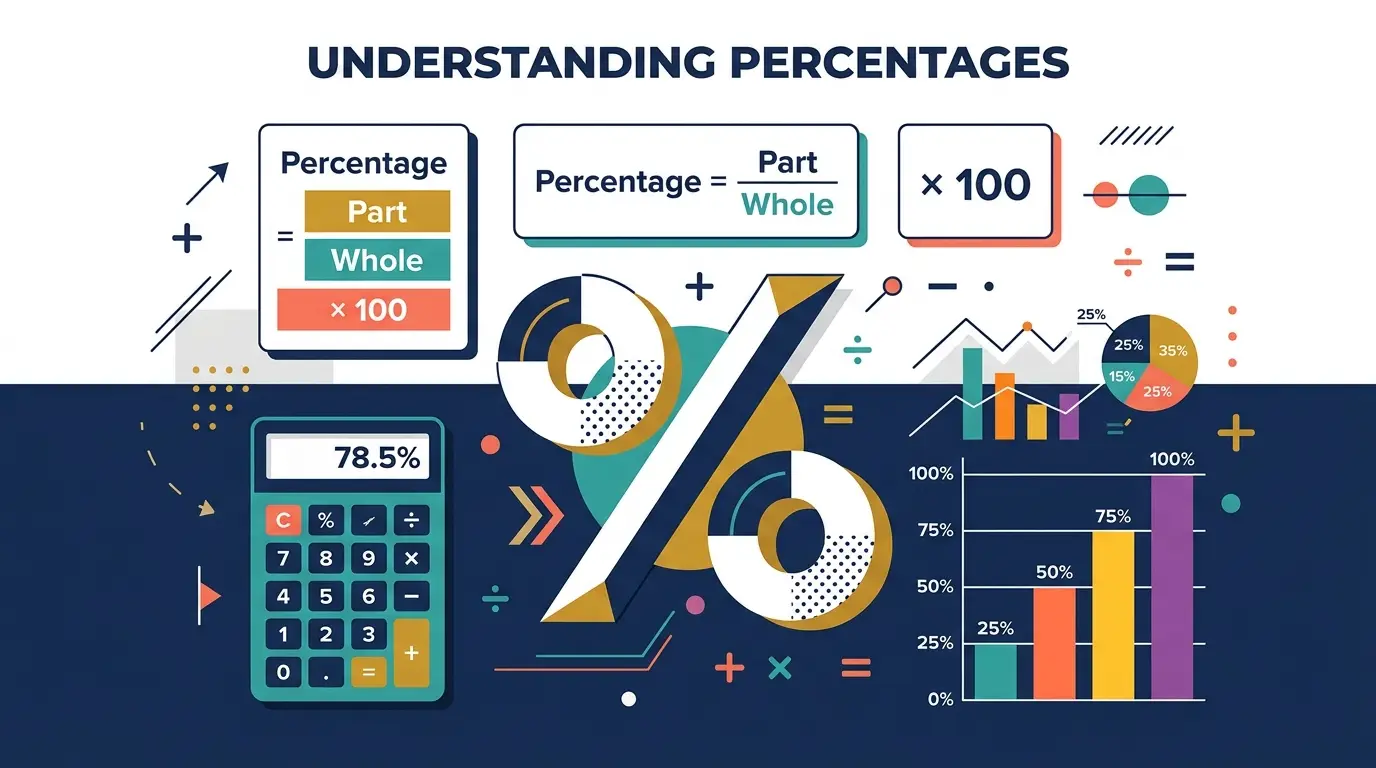
Every percentage problem — no matter how it's phrased — comes back to one equation:
Percentage = (45 ÷ 60) × 100 = 75%
The word "percent" comes from the Latin per centum, meaning "by the hundred." A percentage is simply a ratio expressed out of 100. When you say 75%, you mean 75 parts for every 100.
By rearranging this formula, you can solve for any of the three variables — the percentage, the part, or the whole. All six types of percentage calculation we'll cover are just different arrangements of this same relationship.
"A percentage is a ratio expressed out of 100. Master the three-way relationship between Part, Whole, and Percentage — and every calculation becomes a rearrangement of the same equation."
Type 1: What Is X% of Y? (Finding a Percentage of a Number)
1 This is the most common type: you know the percentage and the total, and you want to find the part. Classic examples include calculating a tip, finding a tax amount, working out a commission, or checking how much of a daily target you've hit.
= (15 ÷ 100) × 240 = 0.15 × 240 = $36
Real-world examples
- Restaurant tip: 18% tip on a $65 bill → (18 ÷ 100) × 65 = $11.70
- Sales commission: 8% commission on $12,000 in sales → 0.08 × 12,000 = $960
- VAT/tax: 20% VAT on a £350 item → 0.20 × 350 = £70 (total = £420)
- Goal tracking: Hit 75% of your 10,000-step goal → 0.75 × 10,000 = 7,500 steps
To find X% of a number, simply multiply the number by X and divide by 100. Even simpler: move the decimal of the percentage two places left, then multiply. So 15% = 0.15, and 0.15 × 240 = 36. No fractions needed.
Type 2: X is What Percent of Y?
2 Here you know both the part and the whole, and you want to find the percentage that expresses their relationship. This is the exam score problem: "I scored 42 out of 55 — what's my percentage?"
= (42 ÷ 55) × 100 = 0.7636 × 100 = 76.36%
Real-world examples
- Exam score: 78 out of 90 → (78 ÷ 90) × 100 = 86.67%
- Market share: A company sold 3,200 units out of an industry total of 50,000 → (3,200 ÷ 50,000) × 100 = 6.4%
- Survey response: 340 people said yes out of 800 surveyed → (340 ÷ 800) × 100 = 42.5%
- Savings rate: You saved $450 out of monthly income of $3,000 → (450 ÷ 3,000) × 100 = 15%
Type 3: Percentage Change — Increase and Decrease
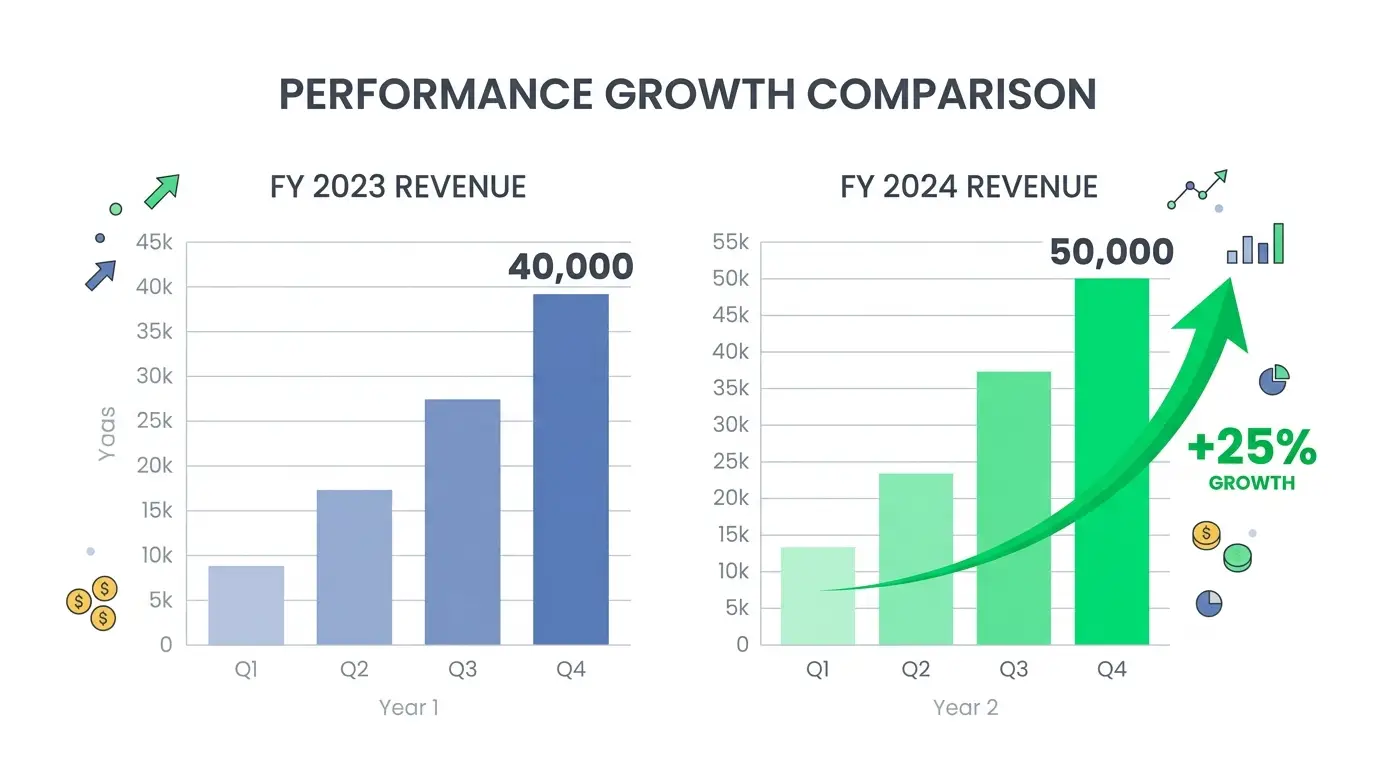
3 Percentage change measures how much a value has grown or fallen relative to its original. This is the formula behind salary raise negotiations, investment returns, weight loss tracking, price comparisons, and inflation figures.
= ((50,000 − 40,000) ÷ 40,000) × 100 = +25% increase
Price drops from $200 to $150:
= ((150 − 200) ÷ 200) × 100 = −25% decrease
Important: use the absolute value of the old number
Notice the formula uses |Old| — the absolute value of the original number. This matters when starting from a negative value. If a company's losses go from −$50,000 to −$30,000, the change is: ((−30,000 − (−50,000)) ÷ |−50,000|) × 100 = (20,000 ÷ 50,000) × 100 = 40% improvement.
A 25% increase followed by a 25% decrease does not return you to the original number. If you start at 100, add 25% (= 125), then subtract 25% of 125 (= 31.25), you end at 93.75 — not 100. Each percentage change uses the current value as its base, not the original.
Type 4: Discount and Sale Price Calculator
4 Walking past a "30% OFF" sign, most people reach for their phone. But with the right formula, you can do this in your head in seconds. The discount formula has two useful outputs: the amount you save, and the final price you pay.
Savings = $120 × 0.30 = $36
Sale price = $120 × 0.70 = $84

Finding the original price from a discount
Sometimes you know the sale price and the discount percentage, and you want to reverse-engineer the original. The formula is: Original Price = Sale Price ÷ (1 − Discount% ÷ 100). For example, if a coat costs $91 after a 35% discount: Original = 91 ÷ 0.65 = $140.
Common discount scenarios
| Discount | Mental shortcut | Example on $100 |
|---|---|---|
| 10% off | Move decimal left by 1, subtract | Pay $90 |
| 20% off | Find 10%, double it, subtract | Pay $80 |
| 25% off | Divide by 4, subtract | Pay $75 |
| 50% off | Divide by 2 | Pay $50 |
| 75% off | Divide by 4 | Pay $25 |
Type 5: Marks to Percentage — Your Exam Score Explained
5 Converting raw marks to a percentage is one of the most searched calculations in education — especially among students in South Asia, where cumulative percentage is the primary academic metric. The formula is the same as Type 2, but applied specifically to exam performance.
= (378 ÷ 500) × 100 = 75.6%

Standard grade boundaries
Grade thresholds vary by institution, but this scale is widely used internationally:
| Percentage | Letter Grade | Description | Status |
|---|---|---|---|
| 90% and above | A+ | Exceptional / Distinction | Pass |
| 80% – 89% | A | Very Good / Merit | Pass |
| 70% – 79% | B | Good | Pass |
| 60% – 69% | C | Average / Satisfactory | Pass |
| 50% – 59% | D | Below Average | Marginal |
| Below 50% | F | Fail | Fail |
Note: universities and boards often set their own boundaries. Always check the specific grading policy for your institution. In some systems (like the UK degree classification), a 40% pass mark is standard at undergraduate level.
Enter your scored marks and total marks — get your percentage and letter grade in one click.
Type 6: Percentage Difference Between Two Values
6 Percentage difference is the most misunderstood type. People often confuse it with percentage change — but they answer fundamentally different questions.
Percentage change measures movement from a specific original value to a new one. It has direction (up or down), and the original value is the reference point.
Percentage difference compares two values symmetrically, with no "before" or "after." It uses the average of the two values as the reference. Use it when comparing two independent data points — two product prices, two survey results, two measurements.
= |950 − 1,200| ÷ ((950 + 1,200) ÷ 2) × 100
= 250 ÷ 1,075 × 100 = 23.26% difference
Did one value come before the other? Use % Change. Are you comparing two independent values where neither is the "original"? Use % Difference. Example: last year's price vs. this year's price → % Change. Shop A's price vs. Shop B's price → % Difference.
Mental Math Shortcuts for Percentages
These shortcuts let you estimate or calculate common percentages in your head — no phone required.
The reverse trick: X% of Y = Y% of X
This is one of the most underused mental math tricks: the percentage and the number can be swapped. 4% of 75 is exactly the same as 75% of 4 — which is just 3. The second version is trivially easy compared to the first. When a percentage looks awkward, try flipping it.
The 4 Most Common Percentage Mistakes
- Confusing the base value. "A 20% increase followed by a 20% decrease" does not return you to the original. After increasing 100 by 20%, you get 120. A 20% decrease on 120 gives 96 — not 100. The base changes with each step.
- Mixing up % change and % difference. These use different denominators. % Change uses the original value; % difference uses the average. Applying the wrong formula produces a different result and a different interpretation.
- Adding percentages of different wholes. "We grew 10% in Q1 and 15% in Q2" cannot be added to "25% annual growth" unless both percentages share the same starting base. If the Q1 base is $100k and Q2 base is $110k, the maths is more complex.
- Forgetting that "percent more" and "percent of" are different. "A is 20% more than B" means A = B × 1.20. "A is 20% of B" means A = B × 0.20. These are dramatically different statements — a classic source of misquotation in media and statistics.
Frequently Asked Questions
The Bottom Line
Every percentage problem reduces to one relationship: Part, Whole, and Percentage — connected by division and multiplication. Once you understand that core triangle, the six calculation types are just different ways of asking the same question with a different unknown.
The fastest way to build intuition is to practise on real numbers you encounter every day: the discount at checkout, the tip at dinner, the grade on an assignment. Do the arithmetic once by hand before reaching for the calculator, and the formula will eventually become automatic.
For everything else — especially multi-step problems like compound growth, percentage of percentages, or cumulative mark calculations — a reliable calculator is the right tool.
CalcMeter's Percentage Calculator handles every type covered in this guide — with the working shown so you can check and learn.